

For some individuals, conditions like severe arthritis, complex fractures, or irreparable rotator cuff tears eventually lead to the need for a joint replacement. Total shoulder replacement and reverse shoulder replacement both aim to relieve pain and restore function. The field of orthopedic surgery is constantly evolving, driven by a commitment to greater precision and better patient outcomes. Today, we’ll focus on one advancement that is transforming how surgeons approach this complex procedure: robotic shoulder surgery. This innovative technology is not replacing the surgeon’s skill but rather enhancing it, providing a level of accuracy and personalization previously unattainable in the operating room.
Key Takeaways
- Robotic systems can allow surgeons to execute a pre-operative plan with a high degree of accuracy, which is helpful for the complex anatomy of the shoulder joint.
- The technology uses a patient’s unique 3D CT scan to create a customized surgical blueprint, helping the surgeon select and position implants more precisely based on the patient’s anatomy.
- The guided system may help limit bone removal and support bone preservation.
The Shoulder’s Complex Anatomy
The ball-and-socket structure of the shoulder joint allows for a wide range of motion, enabling us to reach, throw, and lift with remarkable freedom. This dynamic interplay between bones, tendons, and soft tissues, however, also makes the shoulder particularly vulnerable to injury and degenerative conditions.
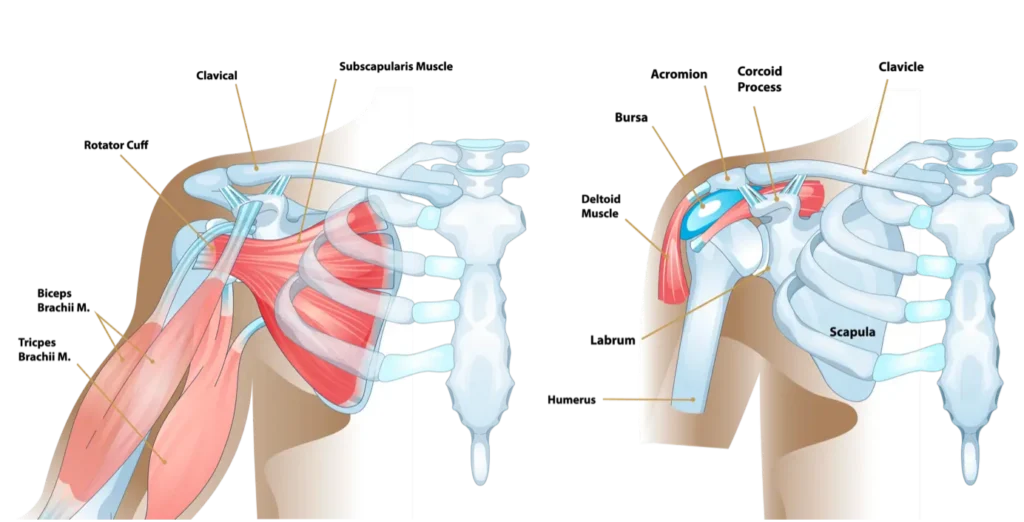
Traditional shoulder replacement surgery relies on the use of conventional instruments to prepare the bone and position the implant. While often effective, this method presents inherent challenges due to the shoulder’s complex anatomy. Achieving the optimal placement and orientation of the implant supports long-term success. Even a slight misalignment can affect the joint’s biomechanics, potentially leading to faster wear, instability, or a less-than-ideal functional result.
Understanding Robotic Shoulder Surgery
Robotic shoulder surgery is an approach that integrates advanced computer technology with the surgeon’s expertise. It is important to understand that the robot does not perform the surgery autonomously. Instead, it functions as a highly advanced, interactive tool that the surgeon controls throughout the procedure.
Depending on the particular platform, the core of this technology usually involves three integrated components: 3D pre-operative planning, the robotic arm, and haptic (touch-guided) feedback. Together, these elements allow the surgeon to plan the procedure with exceptional detail and execute that plan.
The Power of Pre-operative 3D Planning
The journey toward a successful robotic shoulder surgery begins long before the patient enters the operating room. In the pre-operative planning phase, the traditional reliance on two-dimensional X-rays is replaced with a detailed, three-dimensional model of the patient’s shoulder.
Creating a Personalized Blueprint
The process starts with a specialized computed tomography (CT) scan of the patient’s shoulder. This scan captures the precise contours of the bone, including any damage, deformity, or bone loss caused by arthritis or injury. The data from the CT scan is then fed into the robotic system’s software, which generates a high-resolution, interactive 3D model of the patient’s shoulder joint.
Using this virtual model, the surgeon can meticulously plan every detail of the operation. They can virtually place and reposition the implant components to determine the optimal size, position, and orientation. This digital planning allows the surgeon to visualize the final result and make decisions about bone preparation and implant alignment without the pressure of the operating room environment. This is particularly valuable when dealing with shoulders that have significant bone loss or complex deformities, as an experienced shoulder surgeon can anticipate and plan for these challenges in advance.
Precision in the Operating Room: Haptic Guidance
Once the surgeon has finalized the personalized 3D surgical plan, the robotic system’s role shifts to execution. In the operating room, the robotic arm acts as a highly precise extension of the surgeon’s hand, guiding the instruments according to the digital blueprint.
The Role of Haptic Feedback
The key to this precision is a feature called haptic feedback. Haptics refers to the sense of touch, and in this context, the robotic system creates a virtual boundary that corresponds to the surgeon’s pre-operative plan. As the surgeon uses the instrument, the robotic arm provides resistance, or a physical “fence,” that prevents the instrument from moving outside the planned area. This means the surgeon can only prepare the bone within the precise boundaries established during the 3D planning phase.
Optimizing Implant Fit and Longevity
The primary goal of this precision is to provide a more optimal fit and alignment of the artificial joint components. When the components are placed precisely, the forces across the joint are distributed more evenly. This can reduce stress on the implant and the surrounding bone, which may increase the longevity of the artificial joint.
Furthermore, the haptic guidance system promotes bone preservation. By limiting the bone removal to only what is necessary for the implant, the surgeon can conserve the patient’s native bone stock. Preserving bone is a key consideration in joint replacement, especially for younger patients or those who may require a revision surgery in the distant future.
The Benefits of Robotic Shoulder Surgery for Patients
Enhanced Accuracy and Customization
The most immediate benefit is the enhanced accuracy of the implant placement. The shoulder joint is complex, and the ideal position for the socket (glenoid) can vary significantly from person to person, especially in cases of severe arthritis where the bone has eroded. The robotic system can help the implant to be seated where the surgeon planned it, maximizing the contact area and optimizing the joint’s mechanics.
Potential for Improved Long-Term Outcomes
Studies in hip and knee replacement, where this technology has been used for years, suggest that precise component placement may correlate with better long-term survival rates for the implant. While long-term data for robotic shoulder surgery is still accumulating, the underlying principle remains the same: a well-aligned joint is a joint that is less likely to wear out prematurely.
Faster Recovery and Reduced Pain
Some patients and surgeons report a smoother early recovery experience, but pain and recovery vary, and robotics does not guarantee faster healing. However, by preparing the bone with minimal unnecessary trauma, the surrounding soft tissues may experience less irritation.
The Surgeon’s Role: The Essential Element
The robotic system is a tool, not a replacement for the surgeon. The success of robotic shoulder surgery rests entirely on the expertise of the orthopedic surgeon. The surgeon is the one who interprets the patient’s CT scan, develops the personalized 3D surgical plan, and controls the robotic arm throughout the procedure.
The technology may enhance the surgeon’s skill by supporting precision and real-time feedback. The most important skill in the operating room remains the surgeon’s judgment, training, and experienced hand.
In my own practice, robotic shoulder surgery is one of several tools used to support careful planning and precise execution in select shoulder replacement cases.
Summary
By combining advanced 3D imaging with haptic-guided precision, robotic shoulder surgery technology allows orthopedic surgeons to create and execute a personalized surgical plan with increased accuracy. The goal of this enhanced precision is to optimize implant placement, conserve bone, and improve the long-term function and longevity of the artificial joint. Ultimately, the robotic system serves as a tool that may elevate the surgeon’s skill.
Frequently Asked Questions
Is the robot performing the surgery?
No, the robot does not perform the surgery on its own. The orthopedic surgeon remains in complete control throughout the entire procedure. The robotic system acts as a highly sophisticated, interactive guide that helps the surgeon execute the pre-operative plan with extreme precision. The surgeon controls the instruments, and the robot provides haptic (touch) feedback to help the surgeon stay within the precise boundaries defined by the 3D surgical plan.
How does robotic surgery differ from traditional shoulder replacement?
The primary difference lies in the planning and execution phases. Traditional surgery relies on two-dimensional imaging and conventional instruments. Robotic shoulder surgery uses a 3D CT scan to create a virtual model, allowing the surgeon to plan the exact size, position, and orientation of the implant before the operation. During surgery, the robotic arm provides a physical boundary, helping the bone preparation to be executed with accuracy.
Does this technology mean a faster recovery?
While the focus of the technology is on precision and implant longevity, the enhanced accuracy in bone preparation may help contribute to a smoother recovery in some cases. By minimizing unnecessary bone removal, the surrounding soft tissues may experience less trauma.