

Medically reviewed by John Costouros, MD | Reviewed June 2026
When I evaluate patients in their 40s or 50s with severe shoulder arthritis, I often hear the same story. Despite trying conservative treatments, the pain persists. They assume they are too young for shoulder replacement. But for the right patient, shoulder replacement in patients under 60 may restore function and dramatically reduce pain.
The conversation around age and shoulder replacement has shifted meaningfully over the past two decades. When I completed my fellowship work, shoulder replacement was considered a procedure of last resort for older patients. Today, the implant technology, the surgical planning tools, and our understanding of long-term outcomes have all advanced to a point where age alone is rarely the deciding factor. What matters far more is the severity of the damage, what you need your shoulder to do, and whether you and I can build a realistic plan together.
Key Takeaways
- Shoulder replacement in patients under 60 may be considered when joint damage is severe and other treatments have been exhausted.
- Younger patients tend to be more physically active, which means implant longevity and realistic activity expectations are central to the decision.
- Both anatomic total shoulder replacement and reverse shoulder replacement may be appropriate depending on the condition of the rotator cuff and the pattern of joint damage.
- Surgical planning technology, including robotic-assisted techniques, can improve implant fit precision, which matters especially in younger, more active patients.
Why Younger Patients End Up Here
Shoulder arthritis before age 60 is not as unusual as people think. Several conditions can damage the shoulder joint well ahead of normal wear and tear.
Post-traumatic arthritis is one of the most common reasons I see younger patients. A fracture, a severe dislocation, or multiple instability events can accelerate joint breakdown in ways that show up on imaging decades earlier than typical osteoarthritis would.
Inflammatory conditions, including rheumatoid arthritis, can affect the shoulder in younger adults and progressively destroy the joint surface. Avascular necrosis, a condition where the blood supply to the bone is disrupted and the bone begins to deteriorate, can also present in younger patients, sometimes linked to prior steroid use, a history of alcohol use, or certain medical conditions.
And then there are patients who simply drew the short straw with early-onset glenohumeral osteoarthritis. No specific injury, no systemic disease. Just a joint that wore out faster than expected.
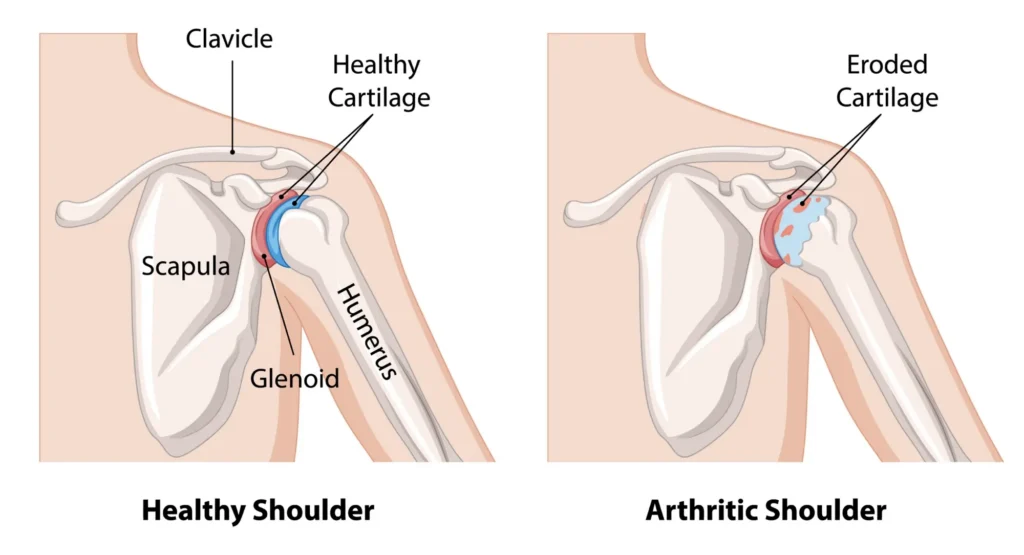
Whatever the cause, by the time a patient in their 40s or 50s sits down with me at my Menlo Park or Fremont office, they have usually been through a long road: anti-inflammatories, cortisone injections, physical therapy, and possibly one or more prior procedures. When the joint surface is severely damaged and the pain is limiting daily activity and sleep, we might have a conversation about shoulder replacement.
What I See in My Younger Patients
Younger patients coming in for this conversation tend to fall into a few categories. Some are still working physically demanding jobs and cannot afford to have a non-functional shoulder. Others are endurance athletes or recreational competitors. A third group is simply people in their late 40s or early 50s who cannot sleep through the night.
What almost all of them share is a well-founded concern about doing this too soon. They have heard that implants wear out, that they might need a revision someday, and they want to understand what they are signing up for.
The honest answer is that implant longevity in younger patients is a real consideration. A 45-year-old who has shoulder replacement may outlive the implant. Long-term data on older designs for total shoulder replacement generally shows that around 90% of replacements are functioning well at 10 years. Improved implant designs and enhancements in technology and technique are leading to improved performance for shoulder replacement implants. For a younger patient, that math means there is a meaningful chance of a second surgery later.
At the same time, waiting longer than necessary carries its own costs. Bone stock continues to deteriorate. Muscle atrophy worsens. And years of severe pain take a real toll on quality of life. My view is that the decision belongs to the patient, but it should be an informed one.
Choosing the Right Procedure
Not all shoulder replacements are the same, and the choice between procedures matters more in younger patients than it does in older ones.
Anatomic total shoulder replacement is appropriate when the rotator cuff is intact and functioning and there is no significant deformity of the socket or bone loss. This approach replaces both the ball (humeral head) and the socket (glenoid) with components designed to mirror the shoulder’s natural anatomy. For a younger patient with a good rotator cuff and relatively normal bone anatomy, this is often the starting point.
Reverse shoulder replacement changes the geometry of the joint, placing the ball on the glenoid side and the socket on the humeral side. It was originally developed for patients with rotator cuff arthropathy, a condition where the combination of a severely damaged rotator cuff and arthritis causes the shoulder to collapse. I was one of the first surgeons to introduce the reverse total shoulder procedure in the United States after the FDA approved it in 2004, and I have seen firsthand how dramatically it can improve function for patients who have no other good options. In younger patients, reverse replacement may be the right choice when the rotator cuff is irreparably damaged or when bone loss makes anatomic replacement less feasible, but it requires a clear understanding and agreement to modify activities moving forward to prevent implant loosening, dislocations, or complications.
The implant system matters too. Glenoid loosening is the leading cause of failure in total shoulder replacement. One device that I consider using in younger, more active patients is the InSet® Shoulder Replacement System because the glenoid sits within a pocket of sclerotic bone rather than on the surface, which dramatically reduces the mechanical stress that causes loosening over time. The humeral components are also bone-preserving, which keeps more options open if a revision is ever needed down the road. For a 48-year-old, those details matter.
Surgical Planning and Robotic-Assisted Precision
Before surgery, I use 3D imaging and advanced planning software to map out the exact placement and sizing of each component based on the patient’s unique anatomy. I am also among a small number of surgeons in the country and around the world who use robotic-assisted surgery for shoulder replacement. Robotic assistance in shoulder surgery allows me to execute the surgical plan with a level of accuracy that goes beyond what the human hand alone can achieve, fitting the components to within about one millimeter of the planned position. For younger patients especially, that precision may support better implant longevity and a more natural-feeling result.
I want to be clear that the technology assists my plan; it does not replace surgical judgment. The most important element in any shoulder replacement is still an experienced surgeon who understands the anatomy and can adapt when the intraoperative picture looks different from the scan.
My Approach to Treatment Decisions in Younger Patients
My threshold for recommending shoulder replacement in a patient under 60 is higher than it would be for someone in their 70s, but it is not impossibly high. In some patients, arthroscopic surgery, or a CAM procedure, which stands for ‘comprehensive arthroscopic management,’ can be a more appropriate treatment. The key factors I weigh are the same ones I consider for any patient, just with more emphasis on long-term durability and activity expectations.
When imaging shows severe joint damage, when the pain is significantly affecting quality of life and sleep, and when the patient has realistic expectations about what surgery can and cannot restore, replacement may become the recommended option. I also consider bone quality carefully. CT imaging helps me assess not just the damage but the structural integrity that remains, which affects which implant type and fixation approach will perform best over time.
Activity restrictions are a real part of the conversation. Shoulder replacement is not designed for high-impact-activities such as heavy weight-lifting at the gym, contact sports, pushups, or activities that require repetitive impact loading onto the shoulder such as boxing. However, most activities such as swimming, tennis, golf, skiing, cycling and other daily activities are unrestricted. Patients who need their shoulder for high-impact demands specifically may need to weigh whether the trade-off makes sense for them.
What Recovery Looks Like
Recovery from shoulder replacement follows a fairly predictable arc, though the timeline varies between patients. Here is the general progression I walk through with anyone considering this procedure.
In the first five weeks, the arm is typically in a sling. During this phase, the focus is on protecting the healing tissues and managing discomfort. A physical therapist will guide the shoulder through passive range-of-motion work, meaning the therapist moves the arm rather than the patient using their own shoulder muscles.
At five weeks following surgery, when soft tissue healing is progressing well, active motion begins. The patient starts using their own shoulder muscles to drive movement. Strengthening work follows, targeting both the deltoid and whatever rotator cuff function remains. For patients who had an anatomic total shoulder replacement with an intact cuff, this phase tends to go more smoothly because the original mechanics are better preserved.
By three to four months, many patients notice real gains in daily function. Full recovery, including maximal strength and range of motion, typically takes around four to six months, though some patients continue improving for a year or more.
Summary
Shoulder replacement in patients under 60 is a decision that deserves careful, individualized consideration. The right candidate is someone whose joint is severely damaged, who has exhausted other reasonable options, and who understands both the potential benefits and the possibility of a longer-term revision procedure. With advanced surgical planning tools, robotic-assisted precision, and implant systems designed with durability in mind, outcomes for younger patients have improved considerably.
If you are under 60, living with significant shoulder pain, and wondering whether replacement might be right for you, the most useful next step is a thorough evaluation with a shoulder specialist who can review your imaging, discuss your goals, and give you an honest assessment of your options. My practice is based in Menlo Park and Fremont, and I see patients from across Northern California and far beyond. Request an appointment and we can look at your specific situation together.
Frequently Asked Questions
Am I too young for shoulder replacement if I am in my 40s or early 50s?
Age alone does not determine whether shoulder replacement is appropriate. What matters more is the severity of the joint damage, the degree of functional limitation, and whether other treatments have genuinely been exhausted. Patients in their 40s and 50s can be candidates when the clinical picture supports it.
Will I need a second surgery at some point?
For a younger patient, there is a possibility of needing a revision procedure later in life. This is a key part of the decision-making conversation, not something to gloss over. An expert shoulder specialist can give you a clear picture of what revision surgery actually involves, so you are making this decision with the information in front of you.
What activities can I realistically return to after shoulder replacement?
Many patients can return to swimming, golf, tennis, cycling, skiing and similar low-to-moderate impact activities. High-impact sports and contact activities are generally not recommended, as they can place excessive stress on the implant. Your surgeon can give you a more specific picture based on your procedure and your goals.