
Medically reviewed by John Costouros, MD
A first shoulder dislocation is frightening. When the shoulder pops out the front, it can tear the labrum away from the socket, and that torn labrum makes the next dislocation more likely. The risk of a repeat dislocation depends greatly on your age and activity level. Bankart repair is the surgery designed to fix that specific injury. It reattaches the torn labrum to the rim of the socket so the shoulder has its stabilizing bumper back. I’ve treated shoulder instability throughout my entire career — from high school and professional athletes to adults who suffered a dislocation from a fall. During my years on the Stanford orthopedic faculty, I trained hundreds of surgeons from around the world on the nuances of this elegant surgery, which today is primarily done arthroscopically.
Key Takeaways
- A Bankart tear is a detachment of the front, lower part of the labrum from the shoulder socket. It’s the most common cause of repeat dislocations.
- Age at the first dislocation matters. A teenager who dislocates has a much higher chance of the shoulder becoming unstable than someone over 50.
- After a Bankart repair, most patients wear a sling for four to six weeks, begin strengthening at about three months, and return to contact sports at five months.
What Is a Bankart Tear?
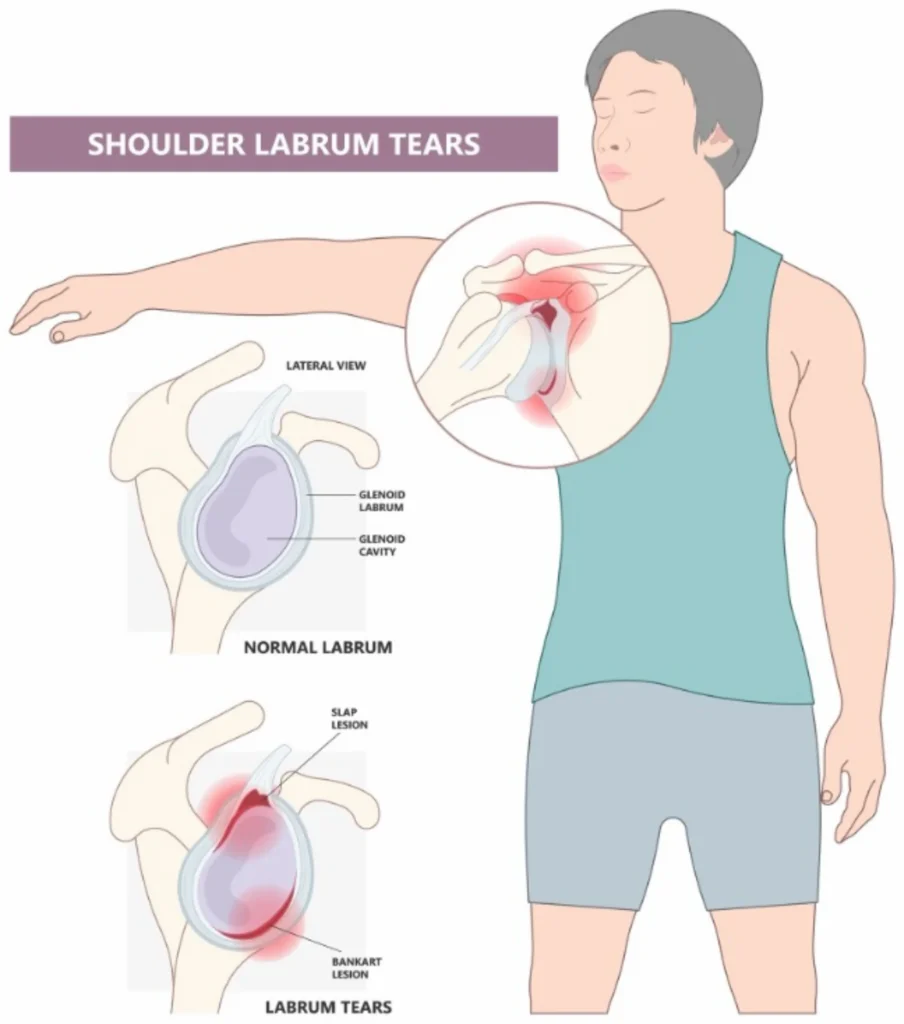
The shoulder is a ball-and-socket joint, but its socket, called the glenoid, is shallow. A ring of fibrocartilage called the labrum lines the rim. It deepens the socket and anchors the ligaments that keep the ball centered.
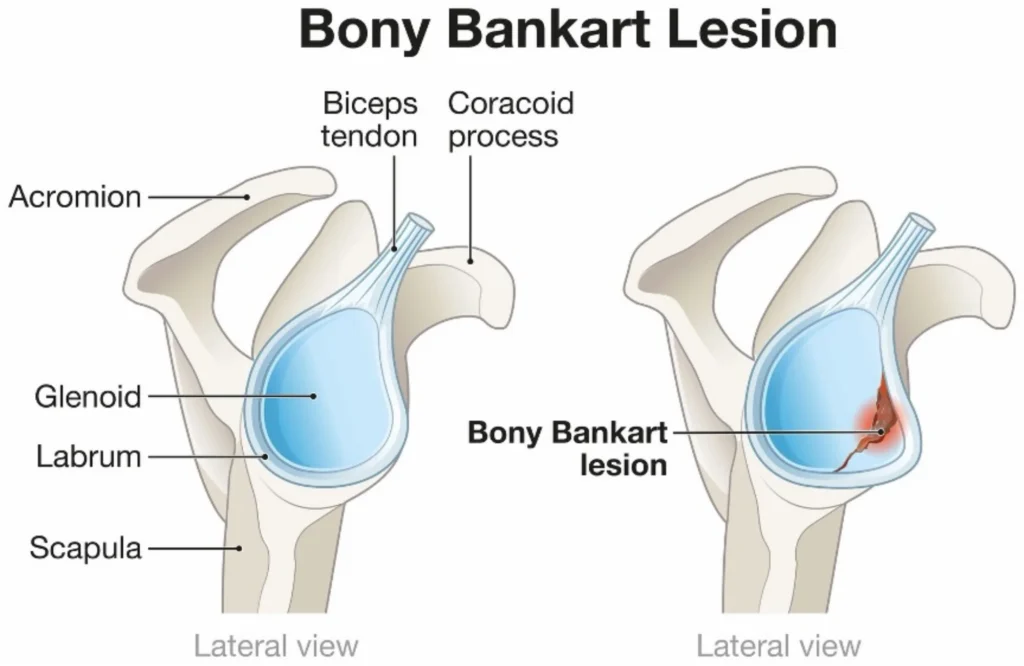
When the shoulder dislocates forward, which is the most common direction of a dislocation, the ball can tear the front, lower labrum off the bone. That injury is called a ‘Bankart lesion’. It’s named for the British surgeon who first described it in 1923.
Sometimes a piece of the socket’s bony rim breaks off along with the labrum. That’s called a ‘bony Bankart’, a type of glenoid fracture. It signals a more forceful injury and in most cases requires surgical treatment.
A Bankart tear is different from a SLAP tear, which affects the top of the labrum where the biceps tendon attaches. Some patients have both. I published a treatment-based algorithm for type II SLAP tears, which outlines how to recognize and treat these specific injuries.
Why a Torn Labrum Leads to Repeat Dislocations
A labrum torn in a dislocation typically does not heal back to the bone, especially in young, active people. Without it, the ball has less to hold it in place, and the ligaments that should tighten at the end of motion are no longer anchored.
Age strongly influences what happens next with shoulder instability. When the first dislocation occurs in the teenage years, there’s roughly a 70% chance that recurrent instability will develop. For people over 50 with a first dislocation, that risk falls below 10%. Older patients carry a different concern: a dislocation later in life is more likely to tear the rotator cuff. These injuries can be detected during a thorough physical examination in the hands of a shoulder specialist or with advanced imaging such as an MRI.
Each additional dislocation can add damage beyond the labrum. Repeated episodes may wear away the front of the glenoid and dent the back of the ball, an injury called a Hill-Sachs lesion. That bone loss matters because it can make a soft-tissue repair less reliable. If bone loss is very severe, other surgical procedures may be necessary to reconstruct the shoulder joint and restore stability. In my view, a young athlete’s first dislocation should prompt a serious conversation about surgery.
Symptoms That Suggest a Bankart Tear
The most telling symptom is apprehension, the sense that the shoulder is about to slip out whenever the arm is raised and rotated back. Many patients notice it when throwing, serving, reaching overhead, or even pulling on a jacket.
The second is recurrence. After a Bankart tear, the shoulder may dislocate or partially slip out with less force each time. Some patients describe dislocating while asleep or rolling over in bed.
Deep pain and a catching sensation inside the joint can also occur, particularly when the labral tear is large.
If your shoulder is still out of place, or your arm or hand feels numb, tingly, or weak after a dislocation, go to an emergency department immediately rather than waiting for an office visit.
How I Diagnose a Bankart Tear
The diagnosis begins with the history of the injury and a focused physical exam. Specific tests, performed gently, can reproduce the feeling of instability and help confirm which direction the shoulder is unstable.
X-rays show whether the shoulder is back in place and whether there is any bone loss. An MRI, sometimes with contrast injected into the joint (an MRI arthrogram), gives me additional information about the soft tissues of the shoulder joint including the presence or absence of a labrum or rotator cuff tear as well as potential cartilage injury or bone loss. When bone loss is a concern, a CT scan may be used to measure how much of the glenoid is missing. All of this information helps guide me to the best treatment to restore stability of the shoulder.
Nonsurgical Treatment vs. Bankart Repair
Not every dislocation needs surgery. Many older patients or those with less intense activity demands can do very well with non-surgical treatment. After a first dislocation, a period of sling immobilization, generally about four weeks, is recommended, followed by physical therapy. Therapy focuses on strengthening the rotator cuff and the muscles around the shoulder blade so they can compensate for the damaged stabilizers. Many patients regain motion after a four- to six-week course of physical therapy, though full recovery may take longer.
Again, this approach can work well for older or less active patients, and for people whose shoulder stays stable once they’re back to normal activity.
Arthroscopic Bankart repair becomes the preferred option when the shoulder keeps dislocating, when instability interferes with sport, work, or sleep, or when a young athlete in a high-risk sport has a clear Bankart tear on MRI. For a young athlete, the medical literature as well as my personal experience has demonstrated that a “wait and see” approach is not the safest option, because each dislocation can damage more labrum, cartilage and bone and potentially accelerate the risk of developing arthritis.
How Arthroscopic Bankart Repair Works
Nearly all Bankart repairs today are performed arthroscopically. Through a few small incisions, I use a small high-definition camera to inspect the anatomy and damage inside of the joint and use specialized instruments to repair and reconstruct the damaged tissues. The torn labrum is mobilized, the bone of the glenoid where the labrum attaches is prepared so it can heal, and small suture anchors are placed in the glenoid to hold the labrum back to its normal position. Tightening the stretched capsule at the same time restores tension to the ligaments. I have published novel surgical techniques to address these injuries arthroscopically, including a trans-cuff portal technique for the back of the shoulder.
When there’s significant bone loss from the socket, a soft-tissue repair alone is less likely to restore stability. In these cases, an open procedure is more successful. One option is called the Latarjet procedure, which transfers a small piece of bone, the coracoid, along with its attached tendon to the front of the socket. The bone block widens the socket, and the tendon acts as a sling across the front of the joint. The bone block can also be obtained from other sources including the pelvis, clavicle, and cadaveric bone. You can see how I perform it in the video below.
Please note that the video below includes real surgical footage, which may be disturbing to some viewers.
What I See in My Patients
In the San Francisco Bay Area, most of my Bankart repair patients are young and active. I see high school, collegiate, and professional athletes who play a variety of overhead and contact sports including football, rugby, hockey, baseball, lacrosse, and even water polo. Sometimes, it’s the skiers and snowboarders coming back from Tahoe after a dislocation suffered on the slopes, or a cyclist falling onto their outstretched arm on their mountain or road bike.
A common pattern: the athlete dislocates, completes a round of therapy, feels strong, and returns to sport. Then the shoulder comes out again in a game or on a hard fall. By the time they reach my office, they’ve usually lost confidence in the arm, and some have stopped playing altogether.
I also see adults in their forties and older who dislocated after a fall. Their exam looks different. For them, the rotator cuff is frequently the primary issue and may require repair rather than the labrum.
My Approach to Bankart Repair
I base my recommendation on several factors: the patient’s age, their sport or activity, the number of dislocations, the amount of bone loss, and the pattern of instability. It’s a framework I’ve also written about for other surgeons. In practice, a 17-year-old water polo player with two dislocations and minimal bone loss is a strong candidate for an arthroscopic Bankart repair. A 51-year-old with a single dislocation and a stable shoulder at three months likely isn’t.
I measure success by being able to restore shoulder stability while also maintaining full range of motion and strength. A stable shoulder that has lost too much rotation and motion is a poor result, and even subtle degrees of motion loss can be devastating in some athletes.
I’m also candid with patients about bone loss. If the CT scan shows a significant defect, I’ll explain why an open procedure or a Latarjet may give them a better chance of a durable result. Choosing the right operation for the amount of bone loss gives the repair its best chance of lasting.
Recovery After Bankart Repair
The recovery below applies after a Bankart repair. It differs from recovery after a dislocation treated without surgery. Timelines may vary between patients.
- Sling: worn for roughly the first four to six weeks to protect the repair while the labrum heals to bone.
- Physical therapy: begins within two weeks of surgery, with gentle, protected motion.
- Range of motion: exercises stressing range of motion continue for about eight to ten weeks after surgery.
- Strengthening: starts around three months after surgery.
- Overhead sports: activities such as baseball or tennis may resume after five months.
- Contact sports: may resume at five months.
The early weeks following surgery call for patience. The repair is at its most vulnerable state during this time before the labrum has healed, and reaching or stretching the arm up and back during that period can stress the anchors and repair. Following the protocol closely protects the result.
Summary
This post covered what a Bankart tear is, why age and repeat dislocations raise the stakes, how the injury is diagnosed, when nonsurgical care makes sense, how arthroscopic Bankart repair works, when an open procedure or Latarjet may be the better choice, and what recovery looks like.
If your shoulder has dislocated once, or if it feels like it’s about to slip out during sport or daily life, request an appointment at my Menlo Park or Fremont office. Bring any MRI or CT images you already have. An exam and a close look at your imaging studies will help guide us on the optimal treatment plan for you — whether it is physical therapy, an arthroscopic Bankart repair, or a different stabilization procedure.
Frequently Asked Questions
How long is recovery after Bankart repair?
Most patients wear a sling for four to six weeks and start physical therapy within the first two weeks. Strengthening typically begins at about three months. Overhead and contact sports may resume around five months. Recovery varies with the individual and the extent of the repair.
Can a Bankart tear heal without surgery?
A torn labrum often doesn’t heal back to the socket in the right position on its own, especially in young, active patients. Physical therapy can strengthen the muscles around the shoulder and may keep some shoulders stable, particularly in older or less active people.
What is the difference between a Bankart repair and a Latarjet?
A Bankart repair reattaches the torn labrum to the socket using small anchors, usually arthroscopically. The Latarjet procedure is an open operation that transfers a small piece of bone and its attached tendon to the front of the socket. It’s generally reserved for shoulders with significant bone loss or a failed prior repair.
Is Bankart repair an outpatient surgery?
In most cases, yes. Arthroscopic Bankart repair is typically performed as an outpatient procedure, and many patients go home the same day with the arm in a sling.