

Medically reviewed by John Costouros, MD | Reviewed May 2026
Rotator cuff arthropathy is a process that unfolds over many years. A rotator cuff tear that was manageable at first. A shoulder that gradually started losing ground. Pain that stopped responding to the usual treatments. By the time I see many of these patients at the Institute for Joint Restoration and Research, the shoulder has changed significantly, and so have the options available to them. Understanding what rotator cuff arthropathy is, how it develops, and what your options might look like is an important first step toward getting clarity on your shoulder condition.
Key Takeaways
- Rotator cuff arthropathy is a form of shoulder arthritis that may develop when a large, long-standing rotator cuff tear gradually changes the mechanics of the joint leading to loss of cartilage and progressive, accelerated wear and potentially bone loss.
- Symptoms can include persistent shoulder pain, weakness with lifting or reaching, and a reduced range of motion that often worsens over time.
- Treatment is highly individual. Non-surgical care may help in some cases, while in others, reverse shoulder replacement may be the recommended option.
A Quick Look at the Rotator Cuff
The rotator cuff is a group of four muscles and their tendons that surround the top of the shoulder joint. These muscles, the supraspinatus, infraspinatus, teres minor, and subscapularis, work together to keep the ball of your upper arm bone (the humerus) centered within the socket of your shoulder blade (the glenoid). They also help you lift, lower, and rotate your arm in many directions.
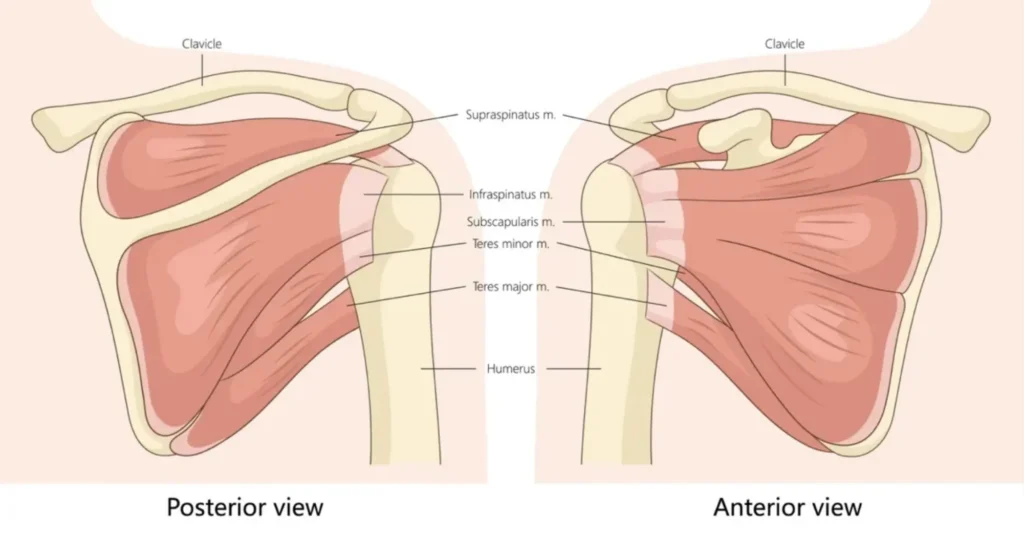
When the rotator cuff is healthy, your shoulder can move smoothly through an impressive range of motion. The tendons act almost like guide ropes, holding everything in proper alignment so the larger muscles around the shoulder can do their work efficiently. Once one or more of these tendons becomes torn, that careful balance can begin to shift, and the consequences may extend well beyond the tendons themselves.
Rotator cuff tears are common, especially as we age. Many tears develop gradually from years of wear and tear, while others may result from a specific injury. Not every tear leads to long-term problems, and some people live with small rotator cuff tears comfortably. However, larger tears that go untreated for many years are the ones most often linked to rotator cuff arthropathy.
What Is Rotator Cuff Arthropathy?
Rotator cuff arthropathy is a specific pattern of shoulder arthritis that tends to develop after a large, long-standing rotator cuff tear. The condition involves both rotator cuff dysfunction and degenerative arthritis within the shoulder joint.
When a substantial rotator cuff tear is present for years, the shoulder may begin to function abnormally. The cuff can no longer hold the head of the humerus securely centered in the glenoid socket. As joint mechanics change, cartilage gradually wears down and the surrounding bones begin to remodel. The result is a shoulder that is both mechanically unstable and progressively arthritic.
This pattern is different from typical osteoarthritis of the shoulder. In many cases of standard shoulder arthritis, the rotator cuff remains relatively functional even as the joint surfaces wear down. With rotator cuff arthropathy, the cuff is significantly damaged, which fundamentally changes how the joint behaves and how it can be treated.
How Does Rotator Cuff Arthropathy Develop?
The development of rotator cuff arthropathy is typically a slow process that unfolds over many years. It often follows a recognizable sequence:
- A large rotator cuff tear develops, either suddenly from an injury or gradually over time.
- The tear is not addressed, or it is too extensive to repair effectively.
- Without adequate cuff function, the head of the humerus may begin to migrate upward toward the acromion.
- The upper part of the humerus begins to rub against the acromion and glenoid, leading to gradual bone changes and cartilage wear.
- Over time, the joint surfaces deteriorate, leading to the arthritic component of the condition.
Several factors can influence how quickly this progression occurs, or if it occurs at all. The size and location of the tear matter, as does how long it has been present. Patient age, activity level, and how much the shoulder is used in daily life can also play a role. In some patients, the changes happen relatively quickly. In others, the process may unfold over decades.
Common Causes and Risk Factors
Rotator cuff arthropathy almost always has a rotator cuff tear at its root. However, certain factors may increase the likelihood that a tear will eventually progress to arthropathy:
- Large or massive rotator cuff tears, particularly those involving multiple tendons
- Tears that have been present for a long time without treatment
- Advancing age, which is associated with a higher prevalence of significant cuff tears
- Repetitive overhead activity from work or sports over the course of many years
- A previous shoulder injury that was never fully evaluated or treated
- A history of failed rotator cuff repair surgery
Genetics may also influence tendon health and how the body responds to wear and tear, although this area is still being studied. Patients with a long history of shoulder problems, particularly those who have noticed gradual weakness alongside chronic pain, may benefit from a careful evaluation.
Recognizing the Symptoms
The symptoms of rotator cuff arthropathy can vary considerably from one patient to another. Some people experience pain with relatively preserved function, while others have more profound weakness with less pain. Common symptoms may include:
- Pain in the shoulder that may worsen with activity and at night
- Noticeable weakness when lifting or reaching, especially overhead
- Difficulty raising the arm, which in some cases progresses to an inability to lift the arm against gravity
- Reduced range of motion, particularly when reaching to the side or above the head
Because rotator cuff arthropathy can resemble other shoulder conditions in its early stages, an accurate diagnosis matters. Symptoms alone do not always tell the full story, which is why a thorough evaluation by an experienced shoulder specialist plays an important role.
Getting a Diagnosis
When rotator cuff arthropathy is suspected, the diagnostic process typically begins with a detailed conversation about your symptoms, how long they have been present, and any previous shoulder injuries or treatments. A physical examination follows, focused on your range of motion, strength, areas of tenderness, and how the shoulder behaves during specific movements.
Imaging studies help confirm the diagnosis and clarify the extent of the condition. X-rays are usually the first step. They can show characteristic findings associated with rotator cuff arthropathy, such as upward migration of the humeral head and changes to the surrounding bone surfaces.
MRI is often used to evaluate the rotator cuff itself in greater detail. It can show how many tendons are torn, how large the tears are, the degree of muscle atrophy or fatty replacement that may have occurred, and the condition of the surrounding cartilage. This information is important for treatment planning, because the state of the cuff and the joint surface may influence which options are most appropriate. In some cases, a CT scan may also be ordered, particularly when more detailed information about the bone is needed or for surgical planning for reverse total shoulder replacement.
Treatment Options
There is no one-size-fits-all approach to treating rotator cuff arthropathy. The right plan depends on the severity of symptoms, the degree of arthritis, the condition of the rotator cuff, your activity level and goals, and your overall health.
Non-Surgical Treatment
For some patients, particularly those with milder symptoms or who are not candidates for surgery, non-surgical care may be a reasonable first step. This approach focuses on managing pain and preserving function as much as possible. Non-surgical options may include:
- Activity modification to reduce stress on the shoulder
- Anti-inflammatory medications, when appropriate, to help manage pain and swelling
- Physical therapy aimed at maintaining range of motion and strengthening the muscles that surround the shoulder
- Corticosteroid injections, which may provide temporary relief in some cases
Non-surgical management does not reverse the underlying changes within the joint, but it may help patients maintain a meaningful level of function and comfort, especially in earlier stages or in patients whose symptoms are limited.
Surgical Treatment
In my practice, when rotator cuff arthropathy progresses significantly and quality of life is meaningfully affected, I discuss surgery as a potential option. The most common and reliable surgical choice for advanced rotator cuff arthropathy is reverse shoulder replacement. This procedure is specifically designed for shoulders where the rotator cuff is no longer functional enough to support a traditional shoulder replacement. I was one of the first surgeons in the United States to bring reverse shoulder replacement to patients after it became FDA-approved in the United States in 2004.
In a reverse shoulder replacement, the normal ball-and-socket configuration of the shoulder is reversed. A metal ball is fixed to the shoulder blade side of the joint, and a plastic socket is attached to the upper arm bone. This change in mechanics allows the deltoid muscle, the large muscle that wraps over the top of the shoulder, to take over the work of lifting the arm, even when the rotator cuff is severely compromised.
In some carefully selected cases, other procedures may be considered, such as arthroscopic debridement to clean out the joint or a partial rotator cuff repair. A traditional total shoulder replacement is generally not appropriate for patients with significant rotator cuff arthropathy, because it relies on a functioning cuff to work properly. Each surgical decision should be made after a thoughtful conversation about the goals, expectations, and trade-offs involved.
Summary
Rotator cuff arthropathy is a specific form of shoulder arthritis that develops over time when a large rotator cuff tear gradually changes the mechanics of the joint. The combination of cuff dysfunction and progressive cartilage wear can lead to persistent pain, weakness, and limited shoulder function. Non-surgical care may help to a degree in some cases, while reverse shoulder replacement is often considered for a more durable and predictable solution when symptoms significantly affect daily life. Working with an experienced shoulder surgeon can help clarify what is happening within the joint and what options may be most appropriate for your specific situation.
Frequently Asked Questions
Is rotator cuff arthropathy the same as a rotator cuff tear?
No. A rotator cuff tear refers specifically to damage to one or more of the rotator cuff tendons. Rotator cuff arthropathy is a more advanced condition that includes both a significant cuff tear and the development of arthritis within the shoulder joint. Many patients live with rotator cuff tears for years without progressing to arthropathy, but a long-standing, large tear may eventually contribute to its development.
How long does recovery from reverse shoulder replacement typically take?
Recovery timelines vary between patients, but the majority of recovery from reverse shoulder replacement often occurs over the first several months. Continued improvement in strength, range of motion, and endurance can take place for up to two years in some cases.
When should I see a shoulder specialist about possible rotator cuff arthropathy?
If you have shoulder pain that has lasted for months, especially if it is accompanied by noticeable weakness, difficulty lifting your arm, or trouble sleeping, it may be worth scheduling an evaluation. A specialist can help determine whether rotator cuff arthropathy or another shoulder condition is contributing to your symptoms and can outline what next steps might look like for your specific situation.