

Medically reviewed by John Costouros, MD
Calcific tendinitis is a condition I’ve studied throughout my career. After my second shoulder and elbow fellowship at Balgrist Hospital in Zürich, I presented research on the arthroscopic management of calcific tendinitis. I shared that work at the American Academy of Orthopaedic Surgeons, the Arthroscopy Association of North America, and the European Society for Surgery of the Shoulder and Elbow. Twenty years later, I still see it regularly in my practice. The pain can be startling, sometimes severe enough to send people to an emergency room. The encouraging part is that calcific tendinitis treatment rarely starts with surgery, and many deposits clear up with time and the right care.
Key Takeaways
- Calcific tendinitis happens when calcium deposits form inside a rotator cuff tendon, most often the supraspinatus.
- The most painful phase frequently occurs while the body is breaking the deposit down, which is one reason many cases improve over time.
- Calcific tendinitis treatment usually begins with nonsurgical options such as anti-inflammatory medication, physical therapy, and targeted injections.
- Arthroscopic removal of the deposit may be considered when pain persists despite several months of nonsurgical care.
What Is Calcific Tendinitis?
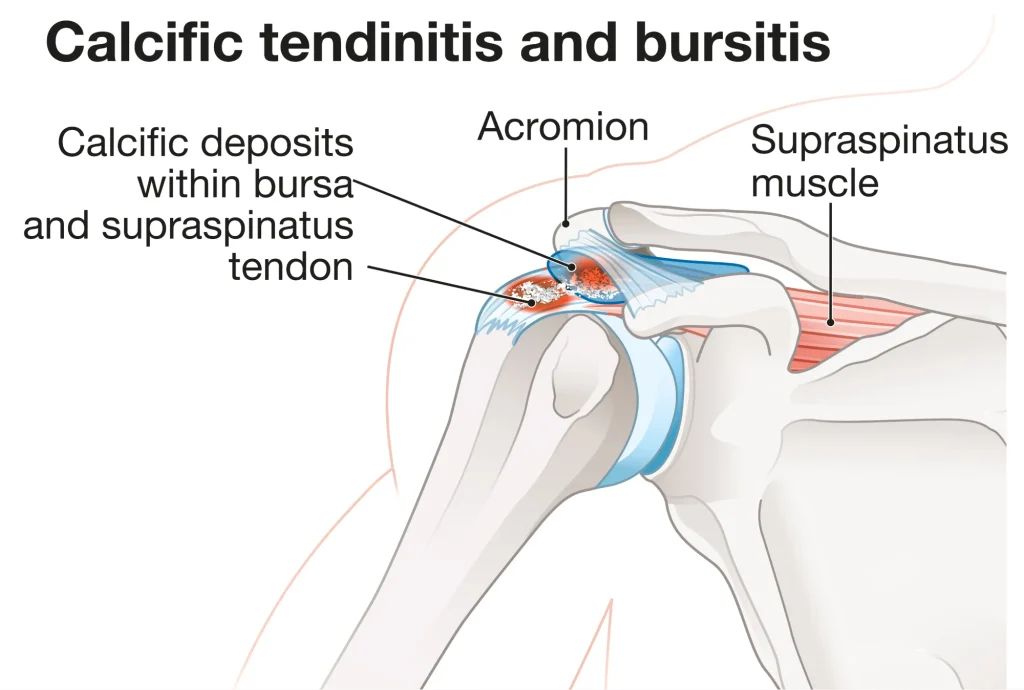
The rotator cuff is a group of four muscles and tendons that keep the ball of the shoulder centered in its socket. In calcific tendinitis, small deposits of calcium crystals build up inside one of those tendons. The supraspinatus, which runs across the top of the shoulder, is the most common site.
These deposits are not bone spurs, and they are not arthritis. They form within the soft tissue of the tendon itself. Researchers still don’t fully understand why they develop, though changes in the tendon’s cells and blood supply appear to play a role.
Calcific tendinitis shows up most commonly in adults between about 30 and 60, and it appears somewhat more frequently in women.
One myth I hear a lot is that drinking milk or taking calcium supplements causes it. There’s no good evidence for that, and I don’t ask patients to change their diet because of a deposit in the shoulder.
Why It Can Hurt So Much
Calcific tendinitis moves through stages. In the first stage, the deposit forms. It has a firm, chalky texture, and some people feel only a mild ache, or nothing at all. The deposit can then sit quietly for months or even years.
Eventually, the body starts to break the deposit down. During this resorptive stage, the calcium softens to something closer to toothpaste, and the area becomes intensely inflamed. This is when many patients experience sudden, severe pain, sometimes overnight, with little or no injury to explain it.
Counterintuitively, that flare can signal that the body has started clearing the calcium. Once the deposit is reabsorbed, the tendon gradually remodels and the pain can settle. I find this one of the most reassuring things to share with someone who is in the middle of a painful flare.
Recognizing the Symptoms
Most patients with calcific tendinitis describe one of two patterns.
The first is a nagging ache at the top or side of the shoulder that worsens when reaching overhead or lying on that side at night. A larger deposit can make the tendon bulky, so it might get pinched beneath the acromion, the bony roof of the shoulder, much like impingement.
The second is an acute flare. The pain comes on quickly, it can be severe, and moving the arm even slightly may feel impossible. These flares often prompt an urgent care visit before patients reach a shoulder specialist.
How I Diagnose Calcific Tendinitis
Unlike a tendon tear, calcium shows up well on a plain X-ray. A standard shoulder X-ray is still one of the most useful tests for this condition, and I look closely at the deposit’s size, shape, and density. A dense, sharply outlined deposit and a fluffy, cloudy one can point to different stages, and that helps guide treatment.
Ultrasound can also show a deposit and is useful for guiding a needle precisely to it. I order an MRI when I want to check the rotator cuff for a tear or another problem alongside the calcium.
What I See in My Patients
Patients come to my Menlo Park and Fremont offices from all over California and beyond. Calcific tendinitis tends to arrive in one of two ways. Some have lived with a low-grade ache for months, then wake up one night with pain so intense they can barely lift the arm. Others learn about a deposit by accident, on an X-ray taken for something unrelated.
That second group often needs the least from me. In my opinion, a deposit that isn’t causing symptoms doesn’t need treatment. Calcium on an X-ray is a finding, not a diagnosis, until it lines up with what you’re feeling.
I also watch for stiffness. Patients who protect a painful shoulder for weeks can lose motion, and in some cases that stiffness can start to resemble frozen shoulder. Keeping the shoulder moving as much as possible despite some degree of pain is very important.
Calcific Tendinitis Treatment Without Surgery
In 2016, I gave a lecture at the Orthopaedic Surgery Controversies meeting titled “Management of Calcific Tendonitis: What and When?” For most patients, calcific tendinitis treatment starts with nonsurgical care, and many never need anything more. Options may include:
- Anti-inflammatory medication, ice, and relative rest to calm a flare
- Physical therapy to maintain range of motion, then rebuild rotator cuff and shoulder blade strength once pain settles
- A corticosteroid injection into the bursa, which can quiet severe inflammation
- Ultrasound-guided lavage, sometimes called barbotage, in which a needle is guided into the deposit to break it up and rinse some of the calcium out
Patience is a part of treatment here. Many deposits are reabsorbed over a period of months, and I generally want patients to give nonsurgical care several months before we discuss an operation.
My Approach to Surgery
I consider surgery when pain and function remain limited after several months of nonsurgical treatment, or when a deposit is large and isn’t changing on follow-up X-rays. When I operate, I typically do it arthroscopically, through small incisions with a camera and specialized instruments.
Finding the deposit is the technical heart of the operation. The calcium sits inside the tendon, so it isn’t always visible from the surface. Once I locate it, I remove as much of the deposit as possible while protecting the healthy tendon around it. If removing the calcium leaves a significant gap in the tendon, I repair that area at the same time, which changes the recovery plan. Sometimes a full rotator cuff repair is required, and in other cases simply performing an augmentation with a graft is sufficient.
Recovery After Arthroscopic Removal
Recovery depends on whether the tendon needed a repair.
When the deposit is removed and no tendon repair is needed, motion exercises with a therapist usually start within the first week and continue for about 8 weeks. Most patients improve steadily over the first few months, though some soreness can linger for 6 months as the tendon recovers.
When the tendon is repaired, the timeline follows a rotator cuff repair. For most repairs, the sling stays on for 4 weeks, including during sleep, with no active use of the shoulder and no lifting during that time. Therapy is carefully controlled for the first 6 to 12 weeks, and full recovery may take more than 6 months. You can read more about each phase in my rotator cuff surgery recovery guide.
Summary
Calcific tendinitis is a buildup of calcium inside a rotator cuff tendon. It can cause anything from a mild ache to a severe flare, and the worst pain sometimes arrives just as the body begins clearing the deposit. Calcific tendinitis treatment starts with nonsurgical care for most patients, with arthroscopic removal reserved for pain that doesn’t respond. If you’ve had sudden, severe shoulder pain or an X-ray has shown calcium in your shoulder, I’d encourage you to schedule a consultation at my Menlo Park or Fremont office. Bring any X-rays you already have, so we can compare how the deposit has changed.
Frequently Asked Questions
Will calcific tendinitis go away on its own?
In many cases, yes. The body can reabsorb a deposit over time, and pain tends to ease as that happens. The process can take months, though, and it’s hard to predict for any one person, so treatment focuses on controlling pain and keeping the shoulder moving in the meantime.
Does eating too much calcium cause calcific tendinitis?
There’s no good evidence that calcium in your diet or from supplements causes these deposits.
How long does calcific tendinitis treatment take without surgery?
A flare may settle within days to a few weeks with medication or an injection. Full resolution of the deposit can take several months. Most patients who improve without surgery do so within that window.
Can the calcium come back after it’s removed?
Recurrence after removal appears to be uncommon, but it can happen. Follow-up X-rays help show whether any calcium remains or returns.