

Medically reviewed by John Costouros, MD | Reviewed July 2026
The subscapularis is not the muscle that tends to get attention in everyday conversation, and even after a diagnosis or a surgical recommendation, many patients leave appointments without fully understanding what this structure does or why their surgeon keeps mentioning it. The subscapularis is the largest of the four rotator cuff muscles, and in my experience, it is one of the most important. How it is treated during shoulder surgery, and how well it heals afterward, can influence outcomes.
Key Takeaways
- The subscapularis is the largest of the four rotator cuff muscles and sits at the front of the shoulder, controlling internal rotation and contributing to overall shoulder stability.
- In shoulder replacement surgery, the subscapularis is often divided to access the joint and must be carefully repaired at the end of the procedure.
- Subscapularis tears can occur independently and may cause weakness with internal rotation, difficulty reaching behind the back, and anterior shoulder pain.
What Is the Subscapularis?
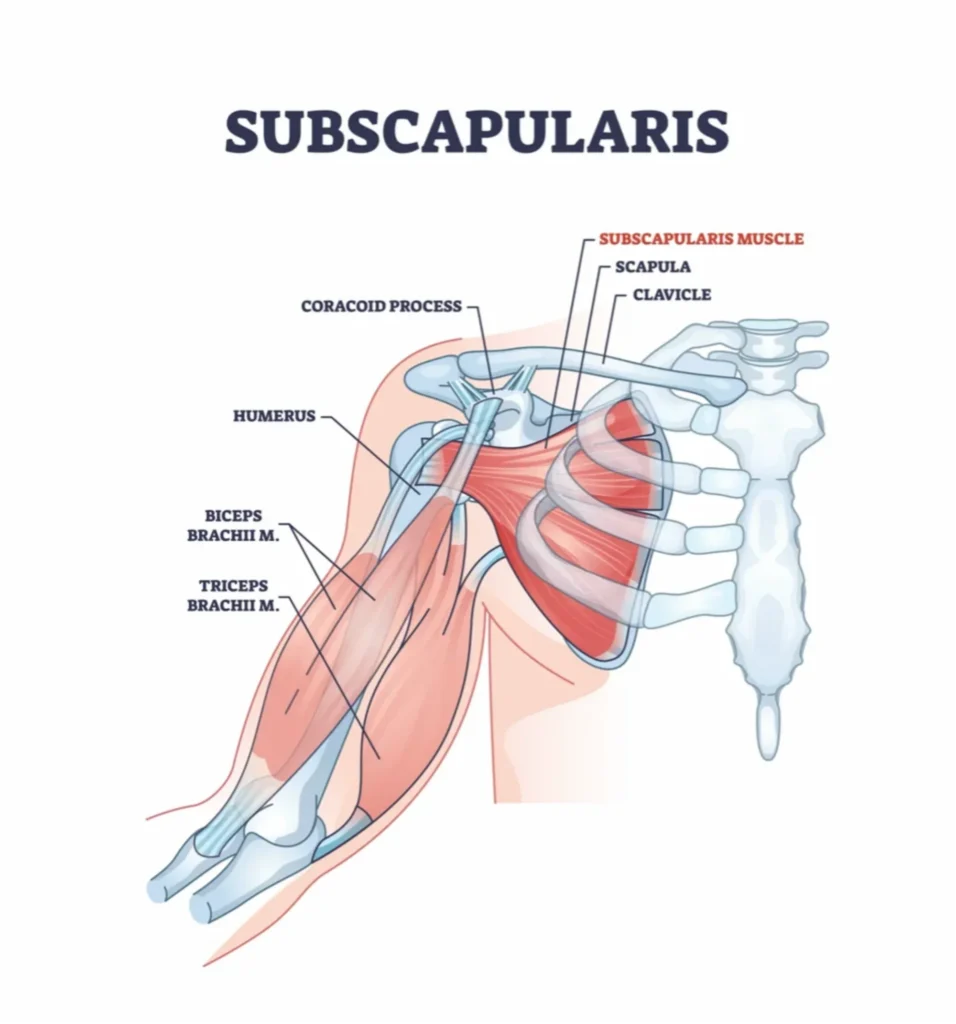
The rotator cuff is made up of four muscles and their tendons: the supraspinatus, infraspinatus, teres minor, and subscapularis. Each plays a distinct role in shoulder movement and stability. The subscapularis is the one that sits on the front of the shoulder blade, and it is the largest of the four.
Its primary job is internal rotation, which is the movement that turns your arm inward toward your body. Think about reaching across your chest, tucking in a shirt from behind, or fastening a seatbelt. The subscapularis drives all of those movements. Beyond rotation, it also helps press the humeral head into the glenoid socket, contributing to the overall stability of the joint so that the other rotator cuff muscles and tendons can function optimally.
When the subscapularis is healthy and functioning well, it works in concert with the other rotator cuff muscles to keep the shoulder balanced and controlled during movement. When it is torn or compromised, that balance shifts, and patients often notice weakness or instability they can’t quite explain.
Why the Subscapularis Matters So Much in Shoulder Surgery
In shoulder replacement surgery, the subscapularis occupies an important place for a straightforward anatomical reason: it sits directly in the way.
The Approach to the Joint
The most common surgical approach to the shoulder joint involves an incision at the front of the shoulder. To reach the ball-and-socket joint, the surgeon must move through or around the subscapularis tendon. In most total shoulder replacement procedures, this means the tendon is detached from its insertion on the humerus to expose the joint adequately.
This is not an arbitrary step. Gaining clear access to the joint is what allows the surgeon to properly prepare the bone surfaces and seat the implant components accurately. The quality of that access matters for the quality of the reconstruction.
The Repair at Closure
Once the shoulder joint has been replaced, the subscapularis tendon must be repaired and reattached. How that repair is performed, and how well it heals, can have an impact on functional outcomes after surgery. A well-healed subscapularis repair supports internal rotation strength, contributes to anterior stability of the joint, and helps protect the implant over time. A repair that fails or heals poorly can limit function and, in some cases, may require additional intervention.
This is one of the reasons I pay close attention to subscapularis quality and condition during pre-operative planning. If the tendon is significantly degenerated, the repair strategy may need to be modified or reverse total shoulder arthroplasty performed. It is also one of the reasons I am specific with patients about the precautions they need to follow in the weeks after surgery. Protecting the repair during early healing is not optional.
Subscapularis Management in Reverse Shoulder Replacement
In reverse shoulder replacement, the role of the subscapularis is somewhat different. Because reverse shoulder replacement fundamentally changes the mechanics of the joint, relying on the deltoid rather than the rotator cuff for primary arm elevation, the subscapularis is not as essential to the biomechanical function of the implant. That said, whether and how to repair it depends on the individual patient’s anatomy, tissue quality, and other factors. The strategy is always individualized.
What I See in Patients With Subscapularis Problems
Isolated subscapularis tears are less common than tears involving the supraspinatus, but they are not rare, and they are frequently underdiagnosed. Part of the challenge is that the symptoms can be subtle or easily attributed to other causes.
Patients with subscapularis tears often notice weakness when rotating their arm inward, difficulty reaching behind their back or across their body, and aching at the front of the shoulder. In some cases, they also experience a sense of instability, particularly when the arm is in certain positions. These are not dramatic symptoms in many cases, which is why a careful physical examination is important.
On imaging, MRI tends to be the most reliable way to evaluate the subscapularis. But I often see cases where MRI findings and clinical findings diverge, and in those situations, clinical judgment takes precedence.
My Approach to the Subscapularis in Shoulder Replacement
In my practice, the condition of the subscapularis is a factor I evaluate carefully before any shoulder replacement. The tendon’s quality, thickness, and mobility all influence how the repair can be performed and what the patient can realistically expect in terms of recovery and function.
I also take the repair itself seriously as a technical step. The way the subscapularis is reattached, the tension it is set at, and the method used to secure it are all decisions that affect the durability and function of the repair. This is not a step to rush through at the end of a long case.
After surgery, I am specific with patients about what they cannot do during the early healing period. For most patients, this means avoiding active internal rotation and external rotation beyond a certain range for the first several weeks. Patients who understand why these restrictions exist tend to be better at following them, which is one reason I explain the subscapularis rather than just handing over a sheet of activity precautions.
Protecting the Subscapularis After Surgery
The subscapularis repair is at its most vulnerable in the first five weeks after surgery. During that window, the tendon is healing back to the bone, and stress on the repair can disrupt that process. This is the period when I am most insistent about specific precautions.
Generally, that means avoiding any movement that forcefully pulls the arm into external rotation, which stretches the subscapularis across the front of the shoulder. It also means avoiding using the arm to push up from a chair or bed, which engages the subscapularis in a way that can stress the repair.
Physical therapy during this phase is carefully controlled. A well-trained therapist who understands subscapularis precautions is an important part of the care team after shoulder replacement, not just a convenience. The progression from passive to active-assisted to full active movement is deliberate for exactly this reason.
Summary
The subscapularis is the largest rotator cuff muscle and one of the most surgically significant structures in shoulder surgery. Whether you are having a total shoulder replacement, a rotator cuff repair, or being evaluated for shoulder pain, understanding what the subscapularis does and why it matters can help you engage more fully with your care.
If you have questions about your shoulder or want to discuss what a specific procedure might involve for your anatomy, request a consultation.
Frequently Asked Questions
Can you tear your subscapularis without injuring the other rotator cuff muscles?
Yes. Isolated subscapularis tears do occur, though they are less common than tears involving the supraspinatus. They can result from a specific traumatic event, such as a forceful external rotation injury, or from gradual degeneration over time. Because the symptoms can be subtle, isolated subscapularis tears are sometimes missed on initial evaluation. A thorough physical examination with tests specific to subscapularis function, along with appropriate imaging, typically clarifies the diagnosis.
How do I know if my subscapularis is torn?
Weakness with internal rotation, difficulty reaching behind your back, and pain at the front of the shoulder are common signs. There are also specific physical examination tests that isolate subscapularis function and can help identify a tear. MRI tends to be the most reliable imaging study for evaluating the subscapularis, though it should be interpreted alongside clinical findings by an experienced shoulder specialist. Partial tears of the subscapularis can generally be managed conservatively and do not always require repair at the time of surgery.
Will I lose internal rotation permanently if my subscapularis is damaged?
Not necessarily. The degree of functional impact depends on the extent of the damage and how well the repair heals. Many patients with subscapularis tears or post-surgical repairs recover meaningful internal rotation strength through dedicated rehabilitation. For patients who undergo shoulder replacement, the subscapularis repair is typically performed as part of the procedure and, when it heals well, can contribute to good internal rotation outcomes.