
Medically reviewed by John Costouros, MD
When a patient points with one finger to the very top of the shoulder, right where the collarbone meets the shoulder blade, I’m thinking about the AC joint. AC joint arthritis is one of the most frequent sources of pain in that spot, particularly in people who lift weights, played contact sports, or simply have many years of use on their shoulders. Because the main ball-and-socket joint gets most of the attention, this small joint can be easy to overlook. I’ve dedicated my entire career to treating shoulder disorders, including many years treating patients in collegiate and professional sports, and I’ve seen how much trouble this little joint can cause. Here are some important points to understand:
Key Takeaways
- The AC (acromioclavicular) joint is where the collarbone (called the ‘clavicle’) meets the top of the shoulder blade. It’s separate from the main ball-and-socket joint.
- AC joint arthritis commonly causes pain at the top of the shoulder that worsens when reaching across the body, pressing overhead, or lying on that side.
- Many patients improve with activity changes, therapy, anti-inflammatory medication, or an injection.
- When pain persists, a minimally invasive procedure that removes a small amount of the end of the collarbone may be considered.
What Is the AC Joint?
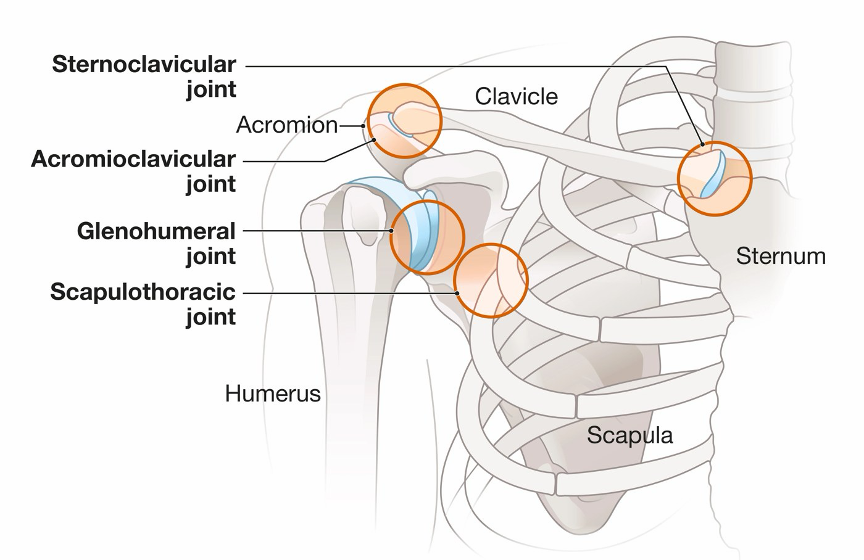
Three bones come together at the shoulder: the upper arm bone (humerus), the shoulder blade (scapula), and the collarbone (clavicle). The AC joint sits where the outer end of the collarbone meets the acromion, the bony roof at the top of the shoulder blade.
It’s a small joint. Its surfaces are lined with cartilage, a small fibrocartilage disc that sits between the two bones, and strong ligaments that provide stability. It doesn’t move much, but it shifts slightly every time you raise or rotate your arm, and it helps transfer force from your arm to the rest of your skeleton.
AC joint arthritis develops when the cartilage in this joint wears down. The bone ends can then rub, swell, and form bone spurs. This is a different problem from glenohumeral arthritis, which affects the main ball-and-socket joint. The two can occur together, but I keep them separate when I evaluate a patient, because the treatments are different. On its own, AC joint arthritis is not typically treated with shoulder replacement.
What Causes AC Joint Arthritis?
Several factors can wear down this joint:
- Age-related wear. The AC joint can show wear on imaging fairly early in life, and many adults over 50 have some degree of AC joint arthritis without any pain.
- A prior injury. An AC joint sprain or separation, often from a cycling fall or a hit in football or rugby, can damage the joint surfaces and lead to arthritis years later.
- Repetitive heavy loading. Bench press, dips, overhead pressing, and manual labor put concentrated stress on this small joint.
In younger lifters, repeated heavy loading can cause a related condition called distal clavicle osteolysis, sometimes nicknamed “weightlifter’s shoulder.” The end of the collarbone becomes irritated and starts to break down. It behaves a lot like early arthritis and is treated in a similar way.
Recognizing the Symptoms
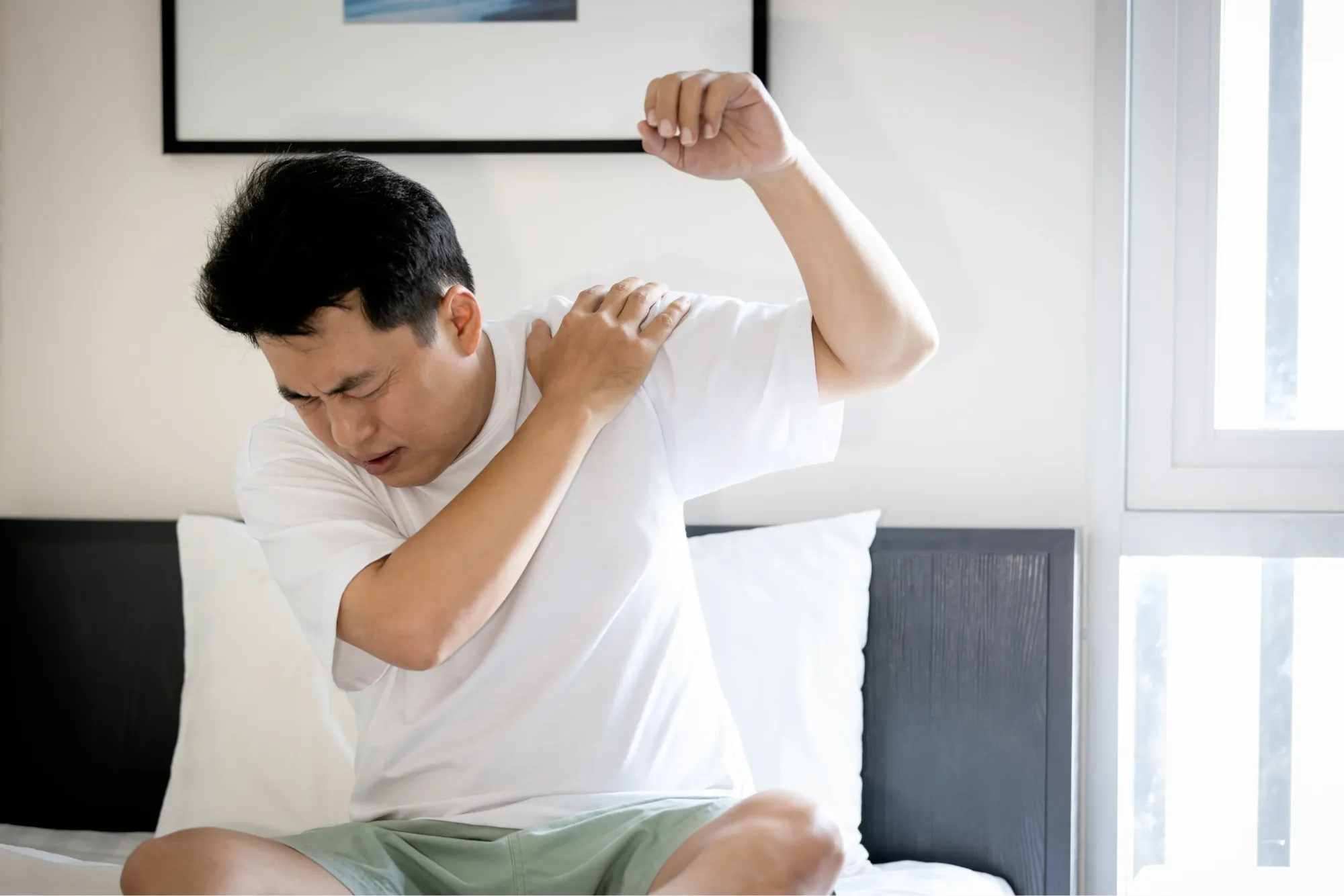
The main symptom I see is pain right on top of the shoulder. Most patients can point to it easily.
Reaching across your body tends to bring it on. Fastening a seatbelt, washing the opposite armpit, or tucking a shirt in behind you all compress the AC joint. Lying on the affected side at night can do the same.
Some patients notice a bump or swelling over the joint, and some feel clicking or grinding with movement. For lifters, the telltale sign may be pain at the bottom of a bench press or during push-ups, dips, or a military press.
How I Diagnose AC Joint Arthritis
I start with the exam. Pressing directly on the AC joint commonly reproduces the pain. I also bring the arm across the chest, which squeezes the joint, and watch for the same familiar discomfort.
X-rays can show narrowing of the joint space, bone spurs, and cysts at the end of the collarbone. An MRI may show swelling in the bone and helps me check the rotator cuff, since AC joint spurs and rotator cuff problems often travel together.
Here’s the catch. Because AC joint wear is so common on imaging, an X-ray showing arthritis doesn’t prove the joint is the source of your pain. When I’m unsure, a diagnostic injection can help. If numbing medication placed into the AC joint takes the pain away, that joint is likely the culprit. The joint is small, so accurate placement matters and as I have published in the medical literature, ultrasound guidance improves accuracy.
What I See in My Patients
AC joint arthritis tends to show up in a few recognizable groups in my Northern California practice. Bay Area weightlifters and CrossFit athletes in their 30s and 40s often arrive with pain at the end of the collarbone that started after a heavy training block.
Cyclists frequently come in years after a fall onto the shoulder. As a cyclist myself, I understand how much people want to get back on the bike, and that shapes how I plan their care.
Another group is adults over the age of 50 whose AC joint wear sits alongside a rotator cuff problem or impingement. For these patients, sorting out which structure is driving the pain matters more than anything else.
My years covering football, hockey, baseball, and other Division I and professional sports gave me a close look at AC joint injuries on the field. Those years showed me how often a separation that seems minor at 20 can lead to a painful, arthritic joint years later.
Nonsurgical Treatment
Many patients with AC joint arthritis improve without surgery. A plan usually combines several approaches:
- Modifying the activities that load the joint, such as narrowing your bench press grip, avoiding dips, and limiting deep push-ups for a while
- Anti-inflammatory medication to calm pain and swelling
- Physical therapy to help improve posture, strengthen the muscles around the shoulder blade, and keep the shoulder moving
- A corticosteroid injection into the AC joint with ultrasound guidance, which may reduce pain and also confirm where the pain is coming from
Small changes in the gym can make a big difference. For many lifters, a few adjustments to grip width and exercise choice can calm the joint without giving up training altogether.
Relief from an injection varies. Some patients feel better for weeks, others for months. I don’t recommend relying on repeated injections as a long-term plan.
My Approach to Surgery
When AC joint arthritis keeps limiting daily life or training after several months of nonsurgical care, and an injection has confirmed the joint as the source, I may recommend a distal clavicle excision. This procedure is sometimes called a ‘Mumford’ procedure. In this procedure, I remove a small sliver from the end of the collarbone so the bones no longer grind against each other. The space typically fills in with scar tissue over time.
I prefer to perform this arthroscopically, through small incisions with a camera. However, in more advanced cases, a small open surgery is most effective and yields excellent results. The key technical goal is removing enough bone to relieve the pain while preserving the ligaments that keep the collarbone stable. If the rotator cuff or the space beneath the acromion also needs attention, I can address those problems during the same procedure.
The AC joint has been a recurring focus of my teaching. I’ve lectured on arthroscopic AC joint reconstruction at meetings in the U.S. and abroad, and I co-authored a study on a minimally invasive AC joint reconstruction technique. Those reconstructions treat unstable joints after a separation rather than arthritis, but they’ve given me a detailed working knowledge of the ligaments I work to protect during a distal clavicle excision.
Recovery After AC Joint Surgery
After a distal clavicle excision with no tendon repair, motion exercises with a therapist start within the first week and run for about 8 weeks. Many patients improve considerably by 2 months. Heavy pressing, like bench press and push-ups, returns last, and I clear lifters individually.
When a distal clavicle excision is combined with a rotator cuff repair, the rotator cuff repair sets the pace. In that case, the sling stays on for 4 to 6 weeks and lifting restrictions can last up to 4 months. I walk through that timeline in my rotator cuff surgery recovery guide.
Summary
AC joint arthritis is wear in the small joint at the top of the shoulder, and it tends to cause pinpoint pain with cross-body reaching, pressing, and sleeping on that side. Many patients do well with activity changes, therapy, and an occasional injection. An open or arthroscopic distal clavicle excision may help when those measures fall short. If shoulder pain has been limiting your workouts or your sleep, I’d encourage you to schedule a consultation at my Menlo Park or Fremont office.
Frequently Asked Questions
Is AC joint arthritis the same as shoulder arthritis?
Not exactly. “Shoulder arthritis” usually refers to the main ball-and-socket joint. AC joint arthritis affects the small joint between the collarbone and the shoulder blade. The two can coexist, but they’re evaluated and treated differently.
Can I keep lifting weights with AC joint arthritis?
For many people, yes, with some changes. Narrowing your grip, avoiding dips, and swapping painful lifts for gentler alternatives may let you keep training while the joint calms down.
How long does a cortisone injection last for AC joint arthritis?
It varies. Some patients get relief for a few weeks, others for several months. If pain keeps returning, we can talk about other options rather than repeating injections indefinitely.
Will my shoulder feel unstable after a distal clavicle excision?
The procedure is designed to remove only a small amount of bone while preserving the ligaments that stabilize the collarbone. When those ligaments are protected, most patients don’t notice any instability.