
Medically reviewed by John Costouros, MD
When patients come to my offices in Menlo Park and Fremont with a report that reads “partial rotator cuff tear,” many assume surgery is the next step. For most of them, it isn’t. A partial rotator cuff tear means part of the tendon is damaged, but the tendon is still attached to the bone. That single detail shapes nearly every decision we make together. I’ve dedicated more than 20 years, my entire career, to exclusively treating shoulder disorders, including many years teaching current and emerging orthopaedic surgeons on the intricacies of arthroscopic and open repair techniques. Here is how I explain these injuries to my own patients, and how I decide what comes next.
Key Takeaways
- A partial rotator cuff tear damages part of the tendon’s thickness, but the tendon remains attached to the bone.
- Many partial tears improve with physical therapy, activity changes, and pain control, so nonsurgical care is where I start for most patients.
- Surgery may be considered when pain and weakness persist after a dedicated course of therapy, or when a tear involves a large share of the tendon.
What Is a Partial Rotator Cuff Tear?
The rotator cuff is a group of four muscles and their tendons: the supraspinatus, infraspinatus, teres minor, and subscapularis. Together, they keep the ball of the upper arm bone centered in the shoulder socket and help you lift and rotate your arm.
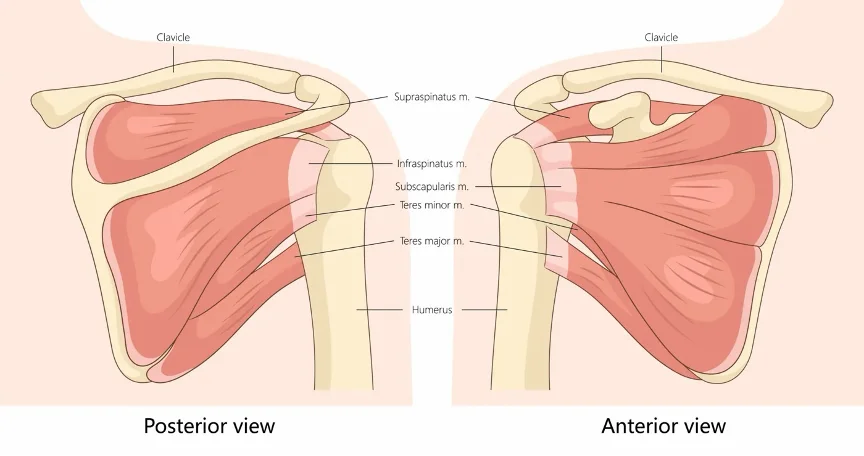
A full-thickness tear goes all the way through a tendon. A partial-thickness tear only goes part of the way. Picture a rope that has frayed on one side but hasn’t snapped. It still holds, but it’s weaker and more irritable than it should be.
Partial tears are described by where they sit in the tendon:
- Articular-side tears affect the underside of the tendon, facing the joint. These are the most common type.
- Bursal-side tears affect the top surface, next to the bursa beneath the acromion (the bony roof of the shoulder).
- Intratendinous tears occur inside the tendon and may not reach either surface.
The supraspinatus, which runs across the top of the shoulder, is the tendon involved in the majority of cases. Location matters, because it shapes both your symptoms and the treatment options we discuss.
What Causes a Partial Tear?
Most partial tears don’t come from a single moment. Instead, they build over years as tendons lose some of their blood supply and elasticity.
Repetitive overhead activity adds stress. Swimmers, tennis and pickleball players, and golfers to name a few load the rotator cuff thousands of times a season. In some people, the tendon also gets pinched beneath the acromion, a problem called impingement.
A fall or a sudden heavy lift can cause a partial tear too, especially in a tendon that was already weakened.
Recognizing the Symptoms
Pain is usually the first sign. It tends to sit at the front or side of the shoulder and can travel down toward the elbow. Reaching overhead or behind your back makes it worse for many people, because those positions narrow the space the tendon passes through.
Night pain is another symptom. Many of my patients tell me that sleeping on the affected side has become impossible, and some wake up every time they roll over.
Weakness can follow, though partial tears are sometimes painful while strength stays close to normal. Some cause no symptoms at all and only turn up on imaging done for something else. That’s one reason I never judge a tear by the imaging report alone.
How I Evaluate a Partial Tear
The evaluation starts with a conversation about when the pain started and what you want to get back to doing. Then I examine the shoulder, checking motion and testing the strength of each rotator cuff tendon.
X-rays come first. They don’t show tendons, but they can reveal bone spurs, arthritis, or calcium deposits that change the picture. An MRI shows the tendon itself, including how deep and how wide a partial tear runs.
In some cases, I use a diagnostic injection. A local anesthetic placed into the inflamed bursa temporarily blocks the pain. If strength returns once the pain is gone, the weakness was likely coming from pain rather than from a large structural tear.
Imaging tells me what the tendon looks like. Your exam and your goals tell me what to do about it. In my view, an MRI finding by itself is rarely enough reason for surgery.
What I See in My Patients
Here in Northern California, partial tears tend to show up in two very different groups. The first is active adults in their 30s, 40s, and 50s, many of them overhead athletes, swimmers, or people who lift weights, who develop a nagging ache that won’t settle. The second is adults over 50 whose tendons have slowly worn, and whose tear turns up on an MRI after a minor strain. As an overhead athlete myself, I understand why my tennis and pickleball players want a plan that gets them back on the court.
A 40-year-old competitive swimmer and a 68-year-old retiree might have tears that look alike on MRI, but their goals, tissue quality, and tolerance for downtime are not the same. Before my current role as Chief of Shoulder Surgery and Medical Director at the Institute for Joint Restoration and Research, I spent years on the Stanford orthopedic faculty. In my experience, the right plan for a partial tear rarely looks the same from one person to the next.
Nonsurgical Treatment: Where I Start
For the majority of partial tears, I begin with nonsurgical care. Many patients with partial rotator cuff tears and impingement improve with this approach alone. A plan may include:
- Physical therapy to strengthen the rotator cuff and the muscles around the shoulder blade, restore lost motion, and help the arm bone sit better under the acromion
- Pausing or modifying the activities that provoke pain, such as overhead serves or heavy pressing
- Anti-inflammatory medication to calm pain and swelling
- A corticosteroid injection into the bursa if symptoms don’t improve with therapy. Other injections may be discussed including stem cells and platelet-rich plasma (PRP) but the literature is less consistent with the effectiveness of these biologic therapies and they are not covered by insurance for this reason.
I’m deliberate about injections. One well-placed injection may calm inflammation enough for therapy to do its job. Repeated injections are another story. Damage to the rotator cuff tendons may occur with more than two or three injections.
I usually ask patients to commit to a dedicated course of therapy before we talk seriously about surgery.
When I Recommend Surgery
Surgery may make sense when pain and function haven’t improved after that course of therapy, when night pain keeps disrupting sleep, or when a tear involves a large share of the tendon’s thickness. Deeper tears, particularly those involving more than about half of the tendon, seem more likely to keep progressing. Younger athletes who depend on overhead strength may also be candidates sooner.
When surgery is the right call, I perform it arthroscopically, through a few small incisions using a camera and specialized instruments. Depending on what I find, rotator cuff surgery for a partial tear may involve:
- Debridement, which smooths away frayed tendon fibers, sometimes combined with a subacromial decompression to remove bone spurs and inflamed bursa
- Repair, which reattaches the damaged portion of the tendon to the bone, either by repairing it in place or by completing the tear and repairing the full tendon
- Augmentation of a partial rotator cuff tear with a patch to add strength and additional structure to a partial tear
Partial tears where the underside of the supraspinatus pulls away from its attachment on the bone have their own name among shoulder surgeons: PASTA lesions. I’ve lectured on advances in PASTA repair at the Orthopaedic Surgery Controversies meeting, and getting the depth and location of these tears right is a big part of choosing between a cleanup and a repair.
Recovery Depends on the Procedure
After debridement, decompression, or augmentation with no tendon repaired, therapy for motion begins in the first week and continues for about 8 weeks. Many patients improve considerably by 2 months.
After a partial tear repair, recovery is slower, because the tendon has to heal back to the bone. For most repairs, the sling stays on for the first 4 to 6 weeks, including during sleep. During that window there is no active use of the shoulder and no lifting, although moving the elbow, wrist, and hand is encouraged. Therapy is carefully controlled for the first 6 to 12 weeks, with a goal of regaining full motion within about 3 months. Lifting restrictions can last up to 4 months, and full recovery may take up to 6 months. My guide to rotator cuff surgery recovery walks through those phases week by week.
Summary
A partial rotator cuff tear is a damaged but still-attached tendon. For many patients, it responds well to therapy, activity changes, and a careful approach to injections. When surgery is needed, it can be done arthroscopically and ranges from debridement to augmentation to a full repair, each with its own recovery timeline. If your shoulder pain has lasted more than a few weeks, keeps you up at night, or an MRI has shown a partial tear, I’d encourage you to schedule a consultation at my Menlo Park or Fremont office. Bring your imaging, and we’ll build a plan around your shoulder and your goals.
Frequently Asked Questions
Can a partial rotator cuff tear heal on its own?
Partial tears usually don’t heal back on their own, but symptoms can still improve a great deal. With therapy, the surrounding muscles grow stronger and inflammation settles, and many people return to their usual activities without surgery.
Will a partial tear turn into a full-thickness tear?
Some partial tears progress over time, especially when the shoulder keeps facing heavy or repetitive overhead load. Others stay stable for years. I monitor symptoms and strength, and I may repeat imaging if something changes.
How long does it take to recover without surgery?
Many patients notice meaningful improvement within 6 to 12 weeks of consistent physical therapy. Getting back to demanding overhead sports can take longer, depending on how the shoulder responds.
How long is recovery after partial rotator cuff tear surgery?
It depends on what’s done. After debridement or augmentation without a repair, many patients feel close to normal by 3 to 4 months. After a repair, the sling is worn for 4 to 6 weeks, lifting restrictions can last up to 4 months, and full recovery may take up to 6 months, with gains possible for up to 2 years.